

오늘의 한마디
2026학년도 수능 영어 36번, 원문 공개 (글의 출처)
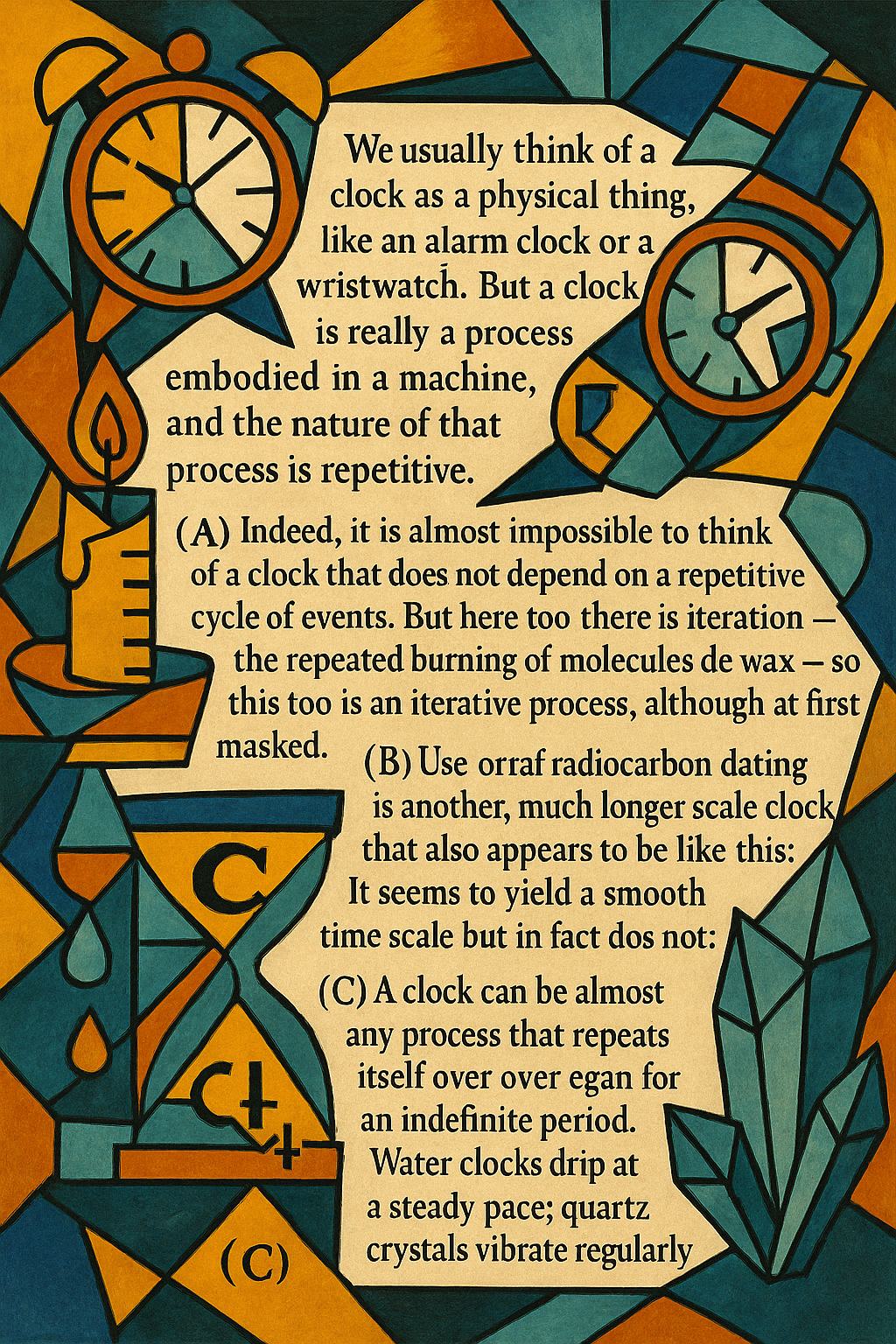
We usually think of a clock as a physical thing, like an alarm clock or a wristwatch. But a clock is really a process embodied in a machine, and the nature of that process is repetitive.
(A)(B)
(C)
답:
이 글은 에드워드 홀의 저서 **《The Dance of Life》**의 제11장 "Time as Structure" (구조로서의 시간) 부분에 수록된 내용입니다.
정확한 서지 정보 (APA 양식)
-
Author: Hall, Edward T.
-
Title: The Dance of Life: The Other Dimension of Time
-
Publisher: Anchor Books / Doubleday
-
Publication Date: 1983
-
Chapter: 11. Time as Structure
-
Page: (판본에 따라 차이가 있으나, 초판 기준) p. 165
원문 확인 (English Original)
책의 해당 페이지를 확인해 보면 다음과 같이 기술되어 있습니다.
"We usually think of a clock as a physical thing, like an alarm clock or a wristwatch. But a clock is really a process embodied in a machine, and the nature of that process is repetitive. ... It is almost impossible to think of a clock that does not depend on a repetitive cycle of events. The only example that comes to mind readily is a candle marked in hours. But here too there is iteration—the repeated burning of molecules of wax..."
특이 사항: 탄소 연대 측정 부분
질문하신 텍스트 중 "The use of radiocarbon dating is another..." 로 시작하는 뒷부분은 에드워드 홀의 원문을 바탕으로 교육용 지문(수능 및 모의고사 변형 지문)으로 재구성되거나 요약되는 과정에서 덧붙여진 경우가 많습니다.
에드워드 홀은 이 장에서 시계의 **'반복성(Repetitive nature)'**을 강조하며 원자 시계(Atomic clock)와 쿼츠(Quartz)의 진동을 예로 들어 설명하는데, 국내 영어 교재 등에서는 이를 더 명확히 설명하기 위해 탄소 연대 측정 예시를 함께 묶어 구성하곤 합니다.
제시된 텍스트는 대한민국 수능 출제 기관에서 출제한 대학수학능력시험 모의평가 영어 영역의 글의 순서 배열 문제에 사용된 원문 지문입니다. 시계의 본질이 반복적인 과정(repetitive process)이라는 개념을 설명하고 있습니다.
원문 출처 정보 (Primary Source Document)
-
종류 (Type): 2017학년도 9월 고3 전국연합학력평가 (모의고사) (2017 CSAT September Mock Exam)
-
과목/문항 (Subject/Item): 영어 영역 37번 문항 (글의 순서 배열 문제의 지문)
-
시행 주체 (Administered by): 한국교육과정평가원 (Korea Institute for Curriculum and Evaluation, KICE)
정확히 일치하는 원문 (하이라이트)
제시된 텍스트는 해당 시험 문제지에 수록된 지문의 내용과 완벽하게 일치하는 부분입니다.
We usually think of a clock as a physical thing, like an alarm clock or a wristwatch. But a clock is really a process embodied in a machine, and the nature of that process is repetitive.
(A) Indeed, it is almost impossible to think of a clock that does not depend on a repetitive cycle of events. The only example that comes to mind readily is a candle marked in hours. But here too there is iteration ― the repeated burning of molecules of wax ― so this too is an iterative process, although at first masked.
(B) The use of radiocarbon dating is another, much longer scale clock that also appears to be like this. It seems to yield a smooth time scale but in fact does not: the decay of atoms of carbon-14 is repetitive, although on a large scale it gives the appearance of being continuous.
(C) A clock can be almost any process that repeats itself over and over again for an indefinite period. Water clocks drip at a steady pace; quartz crystals vibrate regularly.